Everyone knows about generative AI–you know, the iconics like ChatGPT, Gemini, DeepSeek, the list just keeps on going–however, have you heard about agentic AI? Well, for the majority of teens that don’t know, agentic AI is basically a system that acts independently to plan and achieve goals. In addition, massive AI companies are obsessed over it, and are willing to invest whatever they have into it—mainly because of the magic phrase called “potential success."
You may be asking, why should I care? I’m just a teen. I don’t have a job, and AI isn’t going to take something nonexistent. However, agentic AI can also help you save time and effort by completing tasks so you can go back to being a couch potato, or doing whatever hobby you like. While you probably shouldn’t use this on your homework as your teachers might have an AI checker, you still can use it to help you organize or plan your schedule based on due dates or time, the easiest way is to just set it in Google Classroom.
I think that’s enough about how we could abuse agentic AI. So, you may be asking, why is it called “agentic”? ( No one asked but I needed subtopics ). Agentic AI has agents, or in short, scripts it runs through to create different functionalities so that every role is filled. Agents are not different AI, it’s the same AI, just given a “personality”. Underwhelmingly, most AI have agents, and agentic AI merely has the tag “agentic” because it has agents with better functions, such as agents like agentic RAG agents, which is basically an important agent that combines systems such as planning and … uh, reasoning? That can’t be it—right? Last I checked, AI was just plagiarizing information.
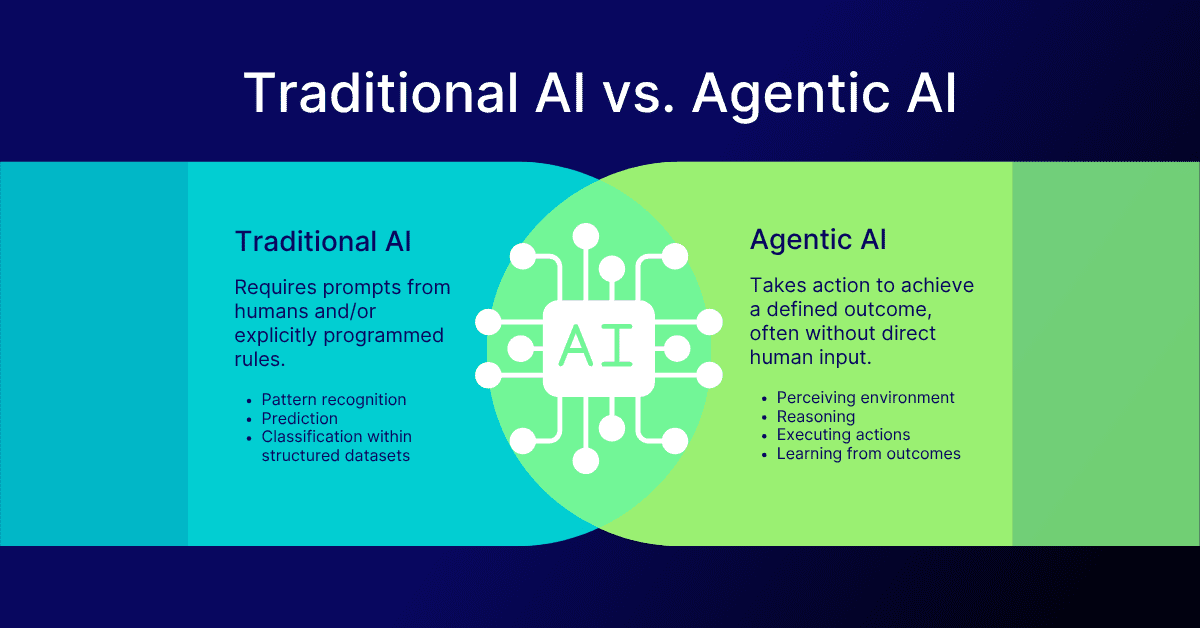
Anyhow, agentic AI isn’t the same as generative AI, even though it may seem like it. So, I’ll provide a little more in-depth explanation for you—without having to read multiple articles to figure it out. Agentic AI works through a system known as the agentic AI loop. However, the loop doesn’t only react to fixed inputs, unlike generative AI where you have to tell it what to do. Every. Single. Time. Instead, the loop uses memory, action, independence, observing, and reasoning—wait a moment, REASONING? So, I wasn’t going crazy after all. But, since when did AI have reasoning? Anyways, the AI combines all of it into a continuous cycle or loop, allowing the AI to notice changes, make decisions, complete tasks, and adapt based on experiences.
Agentic AI is very new, proved by how I never knew about it until I opened up a new tab and searched, “Major changes in AI.” Because of this, agentic AI only has minor achievements, unlike its competitor, generative AI.
But, before you go talking trash about agentic AI, I’m going to one-up you. BOO! AGENTIC AI SUCKS! GET BETTER! Right now, even I have to say, agentic AI isn’t the best compared to the AI we have now, but later on, that may change, with a small, small chance, which in my books means I probably jinxed myself and dug myself too deep for repairs.
My final message to you, the reader, is to go experiment with agentic AI, like Claude Code, if you are interested in coding, or find your own AI to play around with, so you could get familiar with agentic AI before it becomes as relevant as generative AI. You want to be that one friend who knows everything tech related—right? No? Is that just me? Oh, okay. Anyways, be aware that agentic AI still hallucinates and makes up information sometimes, not to mention the price of some platforms. If you’re poor like me, I recommend just waiting until a better free version comes out, so you won’t have debt to pay off.